How to Save for a House Down Payment Fast
Saving for a down payment is simply the process of setting aside a large sum of cash to pay for a portion of your home’s purchase price upfront. This initial payment reduces the amount you need to borrow from a lender, which in turn lowers your monthly mortgage payments and helps you build immediate equity in your property. For many aspiring homeowners, the challenge is not just the amount, but the timeline; learning how to save for a down payment quickly requires a disciplined approach to budgeting and a clear understanding of your specific house savings goal.
Whether you are looking to buy your first condo or a sprawling suburban home, the journey toward your first home savings milestone begins with a shift in your financial psychology. Instead of viewing the down payment as an insurmountable mountain, successful savers treat it as a series of manageable benchmarks. In the current economic landscape, where home prices and interest rates are constantly shifting, having a liquid cash reserve gives you the leverage to act when the right property hits the market. This article is for educational purposes only and does not constitute personalized financial advice. Consult a qualified financial advisor before making significant financial decisions.
The 10-10-80 Framework for Rapid Savings
To accelerate your progress, you need a concrete mental model that goes beyond "saving what is left over." One of the most effective frameworks for prospective homebuyers is the 10-10-80 Homeownership Strategy. In this model, you allocate 10% of your gross income specifically to your down payment fund, 10% to aggressive debt reduction or long-term investments, and live on the remaining 80%.
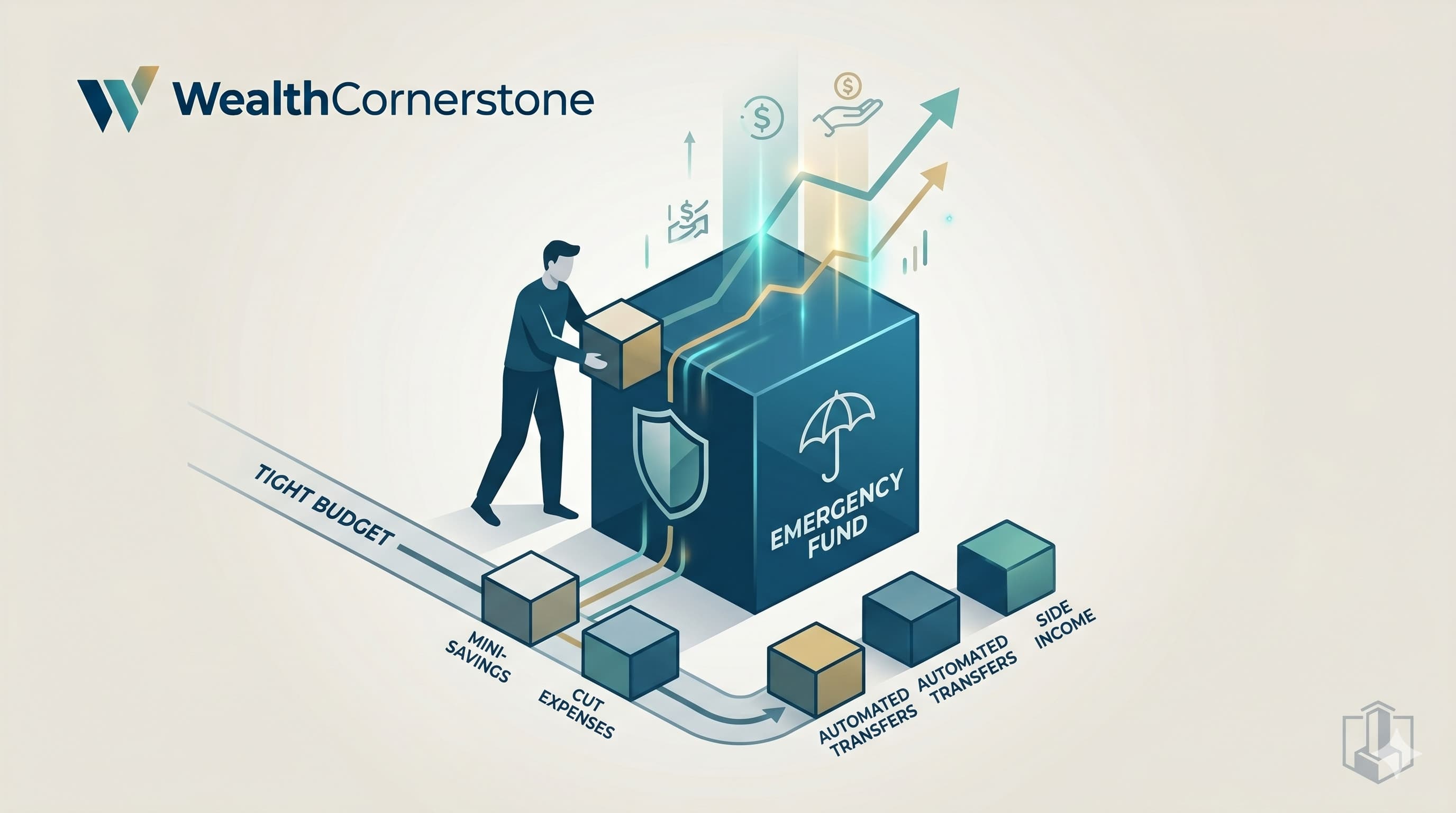
This framework works because it treats your house savings goal as a non-negotiable "bill" that must be paid first every month. By automating this 10% transfer to a dedicated account, you remove the temptation to spend those funds on discretionary items.
Real-World Worked Example: The Thompson Family
Consider Mark and Sarah Thompson, a couple in their early 30s living in a mid-sized city. Their combined household gross income is $110,000 per year. They want to buy a home priced at $400,000 and are aiming for a 10% down payment ($40,000) plus $10,000 for closing costs.
- Gross Monthly Income: $9,166
- Down Payment Allocation (10%): $916.60
- Existing Monthly Savings: $300 (from cutting subscriptions and dining out)
- Total Monthly House Fund: $1,216.60
By adhering to this framework and finding an extra $300 through lifestyle adjustments, the Thompsons are saving $14,599 per year. At this rate, they will reach their $50,000 goal in approximately 3.4 years. Without this structured framework, they previously only managed to save $200 sporadically, which would have put their homeownership dreams nearly 20 years away.
Mapping Your House Savings Goal
Before you can save effectively, you must understand the "why" behind the numbers. Many buyers believe they must save a full 20% down payment to enter the market. While 20% is the traditional gold standard because it eliminates the need for Private Mortgage Insurance (PMI), it is not a legal requirement. In fact, many first-time buyers utilize programs that allow for as little as 3% or 3.5% down.
The table below illustrates the different savings targets for various home price points, helping you identify which tier matches your current financial capacity.
| Home Purchase Price |
3.5% Down (FHA Minimum) |
5% Down (Conventional) |
10% Down (Balanced) |
20% Down (PMI-Free) |
| $250,000 |
$8,750 |
$12,500 |
$25,000 |
$50,000 |
| $350,000 |
$12,250 |
$17,500 |
$35,000 |
$70,000 |
| $450,000 |
$15,750 |
$22,500 |
$45,000 |
$90,000 |
| $600,000 |
$21,000 |
$30,000 |
$60,000 |
$120,000 |
As you can see, the gap between a 3.5% entry point and a 20% conventional down payment is significant. For a $350,000 home, the difference is nearly $58,000. Your strategy should depend on your local real estate market trends; if prices are rising faster than you can save, a lower down payment might be the smarter path to avoid being priced out of the neighborhood entirely.
Use the calculator below to find your number in seconds.
Strategic Accounts and Growth Accelerators
Once you have established your framework and your target number, where you store that money matters as much as how much you contribute. To save for a down payment fast, you cannot leave your funds in a standard checking or basic savings account earning 0.01% interest. You need your money to work for you while remaining safe and liquid.
High-Yield Savings Accounts (HYSA)
The most common and effective vehicle for first home savings is the HYSA. These accounts are typically offered by online banks and provide interest rates that are significantly higher than the national average. Because they are FDIC-insured up to $250,000 per depositor, your principal is protected.
Real-World Scenario: Sarah’s Interest Gains
Sarah is saving $50,000 for her down payment. She currently has $25,000 in a traditional big-bank savings account earning 0.01% interest. Over one year, she earns a mere $2.50 in interest. If Sarah moves that $25,000 to a High-Yield Savings Account earning 4.50% APY, she would earn approximately $1,125 in interest over the same period—without saving an extra penny of her own. That $1,125 covers a significant portion of a home inspection or a professional appraisal.
Certificates of Deposit (CDs) and T-Bills
If your home-buying timeline is fixed at 12 to 24 months, you might consider a "CD Ladder" or short-term U.S. Treasury Bills. These options often provide a slightly higher rate than a standard HYSA in exchange for locking your money away for a specific period. This is ideal for savers who struggle with the "temptation" of having liquid cash available for other purchases.
Windfall Allocation
A "windfall" is any unexpected or non-regular sum of money you receive, such as a tax refund, an annual work bonus, or an inheritance. To accelerate your first home savings, you should commit to a "100% Rule" for windfalls. This means 100% of any extra cash goes directly into the house fund.
Worked Example: Jackson’s Bonus Strategy
Jackson earns a base salary of $65,000 but receives an annual performance bonus of $5,000 (after taxes). He also typically receives a $1,500 tax refund. By committing his entire bonus and refund to his down payment fund, he adds $6,500 to his savings annually. This single habit can shave nearly a full year off his total savings timeline.
The "Perfect Timing" Trap: A Mistake Simulation
The most common and costly mistake prospective buyers make is the "Perpetual Renter’s Paradox." This occurs when a buyer insists on saving a full 20% down payment to avoid PMI, while the real estate market continues to appreciate at a rate that outpaces their savings.
The Simulation: The Miller Family vs. The Market
In 2021, the Miller family decided they wanted to buy a $300,000 home. They had $15,000 saved (5%) but decided to wait until they had $60,000 (20%) to avoid a monthly PMI payment of approximately $150.
They were able to save an impressive $1,000 per month. It took them 45 months (nearly 4 years) to reach their $60,000 goal. However, during those four years, the local housing market grew at an average rate of 6% per year.
- Year 0: Home Price $300,000 (Goal: $60,000)
- Year 4: Home Price $378,743 (New 20% Goal: $75,748)
By the time the Millers hit their original $60,000 target, they were still $15,748 short of a 20% down payment on that same house. Furthermore, because home prices rose, the 80% mortgage they eventually took out was much larger than the one they would have taken out four years prior.
The Cost of Waiting:
- Additional Price Paid: $78,743
- Lost Equity: The $78,743 in appreciation they would have owned if they had bought with 5% down in Year 1.
- Rent Paid: 48 months of rent at $2,000/month = $96,000.
In total, the Millers "saved" $150 a month in PMI but lost over $170,000 in net worth due to market appreciation and rent payments. The lesson is clear: sometimes, paying a small monthly fee for PMI is a strategic move that allows you to capture market gains and stop the "rent leak" sooner.
Leveraging Down Payment Assistance (DPA) Programs
Many people assume that "saving for a down payment" means only using your own wages. However, thousands of federal, state, and local programs exist to help bridge the gap. These programs can take the form of grants (which don't need to be repaid) or low-interest second mortgages that are forgiven after you live in the house for a certain number of years.
- State Housing Finance Agencies (HFAs): Almost every state has an agency dedicated to helping first-time buyers. They often provide down payment assistance equal to 3% to 5% of the purchase price.
- FHA Loans: Insured by the Federal Housing Administration, these allow for a 3.5% down payment and have more lenient credit score requirements (often as low as 580).
- VA and USDA Loans: If you are a veteran or are buying in a designated rural area, you may qualify for a 0% down payment loan. This allows you to redirect your savings toward closing costs and home repairs instead of the down payment itself.
- Employer-Assisted Housing (EAH): Some large employers, particularly in the healthcare and education sectors, offer down payment grants to employees who buy homes near their workplace.
Worked Example: Chloe’s Grant Success
Chloe was struggling to save the last $10,000 she needed for a 3.5% down payment on a $280,000 starter home. She discovered a municipal "Live Near Your Work" grant that provided $5,000 to first-time buyers in her zip code. By combining this grant with a $5,000 gift from her parents, she was able to move her closing date up by 14 months.
Optimizing Your Debt-to-Income (DTI) Ratio
While you are focusing on the "save for down payment" side of the equation, don't ignore the debt side. Your Debt-to-Income (DTI) ratio is a key metric lenders use to determine how much house you can afford. DTI is calculated by adding up all your monthly debt payments (student loans, car notes, credit cards) and dividing it by your gross monthly income. Most lenders prefer a DTI below 43%.
If you have high-interest credit card debt, paying it off can actually be a more effective way to "save" for a home than putting cash in a savings account. Reducing your monthly debt obligations increases your borrowing power, which may allow you to qualify for a better mortgage rate, saving you tens of thousands of dollars over the life of the loan.
Steps to Optimize Your Financial Profile:
- Check your credit score: A higher score can lower your PMI rate and your mortgage interest rate.
- Avoid new debt: Do not finance a new car or open new credit cards while you are in the house-saving phase.
- Review your DTI: Use a simple spreadsheet to list every monthly debt payment. If your car payment is $500/month, paying off that car could increase the mortgage amount you qualify for by approximately $60,000 to $80,000.
Conclusion
Learning how to save for a house down payment fast is a marathon that requires the mindset of a sprinter. By implementing the 10-10-80 framework, utilizing high-yield savings vehicles, and remaining flexible regarding your down payment percentage, you can significantly reduce the time spent in the "saving phase." Remember that the goal is not a perfect 20% down payment, but rather a sustainable path into homeownership that builds long-term wealth.
Your next move is to find your exact numbers and start your dedicated fund. To help you organize your broader financial goals, explore our comprehensive guides on the savings pillar page. Take one action today—whether it is opening a high-yield account or researching a local grant—to bring your first home one step closer to reality.
Frequently Asked Questions
Is it better to save 20% or put less down with PMI?
It depends on your local market and your monthly cash flow. If you put 20% down, you avoid Private Mortgage Insurance (PMI), which can save you $100–$300 per month, and you will have a lower interest rate and more equity. However, if home prices in your area are rising by 5% or 10% annually, waiting years to save that 20% might result in you paying a much higher price for the same house. Many experts suggest that if you have a stable income, putting 3.5% to 5% down to enter the market now is often more profitable in the long run than waiting for 20% while paying rent.
Can I use my 401(k) or IRA to save for a down payment?
Yes, but there are specific rules and risks involved. The IRS allows first-time homebuyers to withdraw up to $10,000 from a Traditional IRA without the 10% early withdrawal penalty, though you will still owe income tax on the amount. For a Roth IRA, you can always withdraw your contributions tax-free and penalty-free, plus up to $10,000 of earnings if the account has been open for five years. You can also take a 401(k) loan, usually up to $50,000 or 50% of your balance, which you pay back to yourself with interest. However, if you leave your job, the loan may become due immediately, so proceed with caution.
How much should I save for closing costs in addition to the down payment?
A common mistake is forgetting that the down payment is not the only upfront cost. You should typically save an additional 2% to 5% of the home’s purchase price for closing costs. These include loan origination fees, title insurance, home inspections, appraisals, and government recording fees. For a $300,000 home, this means you should have between $6,000 and $15,000 set aside specifically for closing. Some buyers negotiate "seller concessions," where the seller pays these costs, but in a competitive "seller's market," you should be prepared to cover them yourself.