

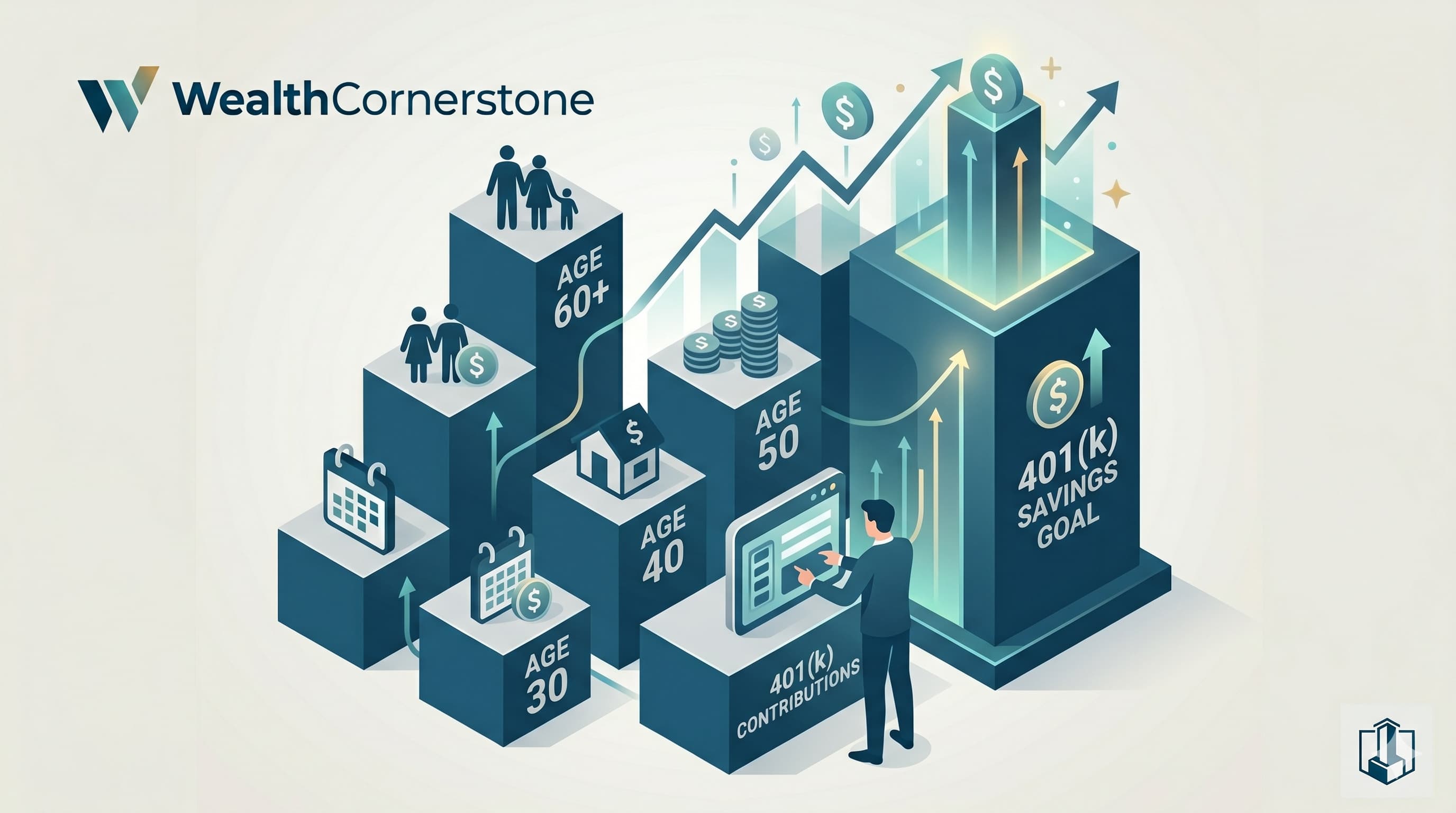
Planning for retirement raises one question more than any other: Am I saving enough? Age-based 401k by age benchmarks give you an honest answer without needing a spreadsheet. They translate an abstract retirement number into a concrete, year-by-year gut-check you can actually use.
This updated guide covers the 2025–2026 IRS contribution limits (including the new SECURE 2.0 "super catch-up" for ages 60–63), shows how real Americans compare using the latest Vanguard and Fidelity data, and outlines concrete strategies whether you're on track or playing catch-up.
Why Age-Based Benchmarks Matter for Your 401(k)
Age-based retirement benchmarks aren't arbitrary. They're designed around two inescapable realities: compound interest rewards early savers, and a shorter time horizon punishes late starters.
Every year you delay saving, you lose not just one year of contributions but every year of growth those contributions would have generated. Missing a single year in your 20s can require two or three extra years of saving in your 50s to produce the same outcome. The benchmarks reflect this math and give your retirement savings goals a concrete yardstick.
401(k) Benchmarks by Age — At a Glance
Most major financial institutions — Fidelity, Vanguard, T. Rowe Price — converge on salary multiples as the clearest way to express retirement readiness. These assume a target retirement age of around 67 and a goal of replacing roughly 70–80% of pre-retirement income.
| Age | Recommended Balance | Example (if salary = $80k) |
|---|---|---|
| 25 | ½× salary | $40,000 |
| 30 | 1× salary | $80,000 |
| 35 | 2× salary | $160,000 |
| 40 | 3× salary | $240,000 |
| 45 | 4× salary | $320,000 |
| 50 | 6× salary | $480,000 |
| 55 | 7× salary | $560,000 |
| 60 | 8× salary | $640,000 |
| 67 | 10× salary | $800,000 |
These are guideposts, not pass/fail grades. Your actual target depends on factors covered in the next sections.
Breaking Down the Benchmarks by Decade
Your 20s — Laying the Foundation
Starting early is the single biggest advantage in retirement savings. Even modest contributions in your 20s generate decades of compound growth. Aiming for ½× your salary by 25 and 1× by 30 sounds ambitious when you're early in your career, but contributing even 6% of a $50,000 salary — especially with an employer match — gets you there faster than you'd expect.
Example: At 22, you earn $45,000 and contribute 6% ($2,700/year) with a 3% employer match ($1,350). That's $4,050/year. At a 7% average annual return, you'd have roughly $55,000 by age 30 — slightly behind a 1× benchmark on a $55,000 salary by then, but well ahead of the median American your age.
The priority at this stage: capture the full employer match. Every dollar left on the table is a 50–100% immediate loss.
Your 30s — Building Momentum
Your 30s typically bring salary growth, which cuts both ways: the benchmarks rise as your income rises, but so does your contribution capacity. Many people face competing financial demands — mortgages, childcare, student loans — but this is the decade where the gap between "on track" and "behind" begins to compound meaningfully.
By 35: 2× salary. If you're not there yet, closing the gap by 40 is very achievable. Adding just 2% more to your contribution rate now translates to tens of thousands extra by retirement.
Your 40s — Peak Earning, Peak Importance
The 40s are the most consequential decade. You likely have your highest-ever income, but retirement is close enough that the math starts becoming urgent. Hitting 3× salary by 40 and 4× by 45 keeps compounding on your side.
If you're behind, don't panic — but don't wait. A gap that's a 10-year problem in your 40s becomes a 5-year crisis in your 50s.
Your 50s — Acceleration Phase
At 50, two things happen: the benchmarks jump sharply (to 6× salary) and the IRS unlocks catch-up contributions. This is the decade to max out every possible tax-advantaged dollar (see the contribution limits section below).
By 55: Aim for 7× salary. At this point your portfolio size matters more than your contribution rate — a large balance growing at 7% generates more wealth per year than even aggressive new contributions.
Your 60s — The Final Stretch
By 60: Target 8× salary. You may be a few years from retirement, and your portfolio should be gradually shifting toward a more conservative allocation to protect what you've built.
By 67: The widely cited target is 10× your final salary. At this balance, a 4% annual withdrawal — the classic safe withdrawal rate — replaces most of a typical income without depleting the portfolio. For a $120,000 final salary, that's a $1.2M balance generating $48,000/year, supplemented by Social Security.
Reality Check — What People Actually Have Saved
Benchmarks tell you where you should be. Here's where Americans actually are, based on Vanguard's How America Saves 2025 report:
| Age Range | Average Balance | Median Balance |
|---|---|---|
| Under 25 | $6,900 | $2,200 |
| 25–34 | $42,600 | $14,900 |
| 35–44 | $103,600 | $36,900 |
| 45–54 | $188,600 | $61,100 |
| 55–64 | $271,300 | $88,800 |
| 65+ | $299,400 | $87,700 |
The median numbers are the honest picture. Averages are pulled upward by a small number of very large balances. The median 45-year-old has about $61,000 saved — well below the 4× salary benchmark most financial planners recommend. This isn't meant to be discouraging; it shows that most people are behind, which means there's no shame in being behind — and also that catching up is a genuine possibility with deliberate action.
2025–2026 IRS Contribution Limits (Updated)
Knowing the limits is essential — maxing out your 401(k) is one of the most efficient things you can do for long-term wealth.
Standard Employee Contribution Limit
| Year | Limit |
|---|---|
| 2025 | $23,500 |
| 2026 | $24,500 |
Catch-Up Contributions (Age 50–59 and 64+)
Workers 50 and older can contribute an additional amount on top of the standard limit:
| Year | Catch-Up | Total |
|---|---|---|
| 2025 | $7,500 | $31,000 |
| 2026 | $8,000 | $32,500 |
SECURE 2.0 "Super Catch-Up" (Ages 60–63 Only)
Under the SECURE 2.0 Act, workers who turn 60, 61, 62, or 63 in a calendar year qualify for a larger catch-up contribution. This provision began in 2025 and significantly boosts what near-retirees can shelter from taxes:
| Year | Super Catch-Up | Total (60–63) |
|---|---|---|
| 2025 | $11,250 | $34,750 |
| 2026 | $11,250 | $35,750 |
This is one of the most underutilized opportunities in retirement planning. If you're in this age window and haven't adjusted your contributions, run the numbers now.
New in 2026: Roth Catch-Up Requirement for High Earners
Starting January 1, 2026, workers age 50 or older who earned more than $150,000 in FICA wages in the prior year must make their catch-up contributions on a Roth basis — meaning after-tax dollars, tax-free in retirement. This is mandatory, not optional. Earners at or below $150,000 may continue making catch-up contributions to either pre-tax or Roth accounts.
IRA Limits (2026)
Your 401(k) isn't your only tax-advantaged option. For 2026:
- IRA contribution limit: $7,500 (up from $7,000 in 2025)
- IRA catch-up (50+): $1,100 additional
Factors That Make Your Personal Target Different
The salary-multiple benchmarks assume a fairly average retirement. Your real number may be higher or lower based on:
- Desired lifestyle: Extensive travel, a second home, or supporting family members in retirement all require a larger nest egg. A modest lifestyle costs less.
- Other retirement income: A pension, rental income, or part-time work in retirement reduces how much your 401(k) needs to cover. So does a higher-than-average Social Security benefit.
- Retirement age: Retiring at 55 instead of 67 means funding 12 extra years and losing 12 years of contributions. Early retirees typically need 25–33× annual expenses — significantly more than the 10× salary benchmark implies.
- Health and longevity: Planning to 90 or 95 requires substantially more than planning to 80. A longer life is a wonderful problem to have — but it requires a larger portfolio to fund.
- Inflation: Your savings must outpace inflation over decades. A 3% average inflation rate cuts purchasing power in half over roughly 23 years. Your portfolio needs real (after-inflation) growth, not just nominal growth.
Alternative framework: Some advisors prefer the 4% rule: calculate how much income you'll need from your portfolio each year, multiply by 25, and that's your target. For example, if you'll need $60,000/year from savings (after Social Security), your target is $1.5 million. This can be more precise than salary multiples for people whose expenses differ significantly from their income.
Scenario: Marco, 42, has 2.5× his salary in his 401(k) — slightly behind the 3× benchmark. But he also has a Roth IRA with $85,000 and expects a small pension from his government job. His combined retirement picture is considerably stronger than his 401(k) balance alone suggests.
Strategies to Build a Stronger 401(k)
Whether you're ahead of the 401k by age benchmarks or catching up, these moves have the highest return:
- Capture the full employer match — first. This is a 50–100% instant return on your contribution. No investment can reliably beat it. If you're not getting the full match, you're leaving free money behind.
- Automate annual increases. Many 401(k) plans let you set automatic 1% contribution increases each year. Enable it. You'll rarely notice the difference in your paycheck, but the cumulative effect over a decade is dramatic.
- Use the SECURE 2.0 super catch-up if you're 60–63. Contributing the full $35,750 in 2026 rather than the standard $24,500 means an extra $11,250 per year sheltered from taxes. Over four years, that's $45,000 in additional tax-advantaged growth.
- Don't overlook a Roth 401(k). If your plan offers it, Roth contributions grow tax-free and create tax diversification in retirement — especially valuable if you expect to be in a higher bracket later. The 2026 mandatory Roth catch-up rule for high earners makes this more relevant than ever.
- Rebalance annually. Your asset allocation (mix of stocks, bonds, and other assets) drifts as markets move. Rebalancing back to your target keeps your risk level appropriate for your age and timeline. Review your asset allocation each year.
- Protect what you've built. Never withdraw early. A $30,000 withdrawal at 45 costs you the 10% penalty ($3,000), income taxes (often another $6,000–9,000), and every year of growth that money would have generated — potentially $120,000+ by retirement at a 7% return.
What If You're Off Track?
Most Americans are behind the benchmarks. That's the reality the Vanguard data shows clearly. Being behind doesn't mean retirement is out of reach — it means the plan needs adjustment. Here's how to close the gap:
- Increase your contribution rate immediately. Even jumping from 6% to 9% this year adds meaningful dollars over a decade. Use your next raise as a trigger — commit to directing half of any raise to your 401(k).
- Audit your budget. Most people find 1–3% of income they can redirect to savings without dramatically changing lifestyle. Subscription audits and eliminating dormant recurring charges are common wins.
- Pursue higher income. A raise, promotion, or side income doesn't just help now — it raises the ceiling for future contributions and shrinks the salary multiple you need to hit.
- Consult a fee-only financial advisor. A flat-fee advisor (not commission-based) can model your actual situation, optimize your Social Security claiming strategy, and create a realistic catch-up plan. Worth the cost if you're significantly behind in your 50s.
- Don't cash out when changing jobs. Rolling your old 401(k) into your new employer's plan or a rollover IRA preserves the balance and keeps it compounding. Cashing out triggers taxes and penalties and resets your progress.
Conclusion
The 401k by age benchmarks — ½× salary by 25, rising to 10× at retirement — are the clearest, most actionable way to gauge your retirement readiness. They're not perfect, but they're far better than guessing.
The 2025–2026 contribution limits, including the SECURE 2.0 super catch-up for ages 60–63, give workers more room than ever to accelerate savings. Whether you're hitting every benchmark or working to close a gap, the most important move is to act now — not when you get to the next milestone.
Start where you are. Increase by 1%. Get the full match. Revisit next year.
Frequently Asked Questions
What if I am far behind the benchmarks — is it still worth saving aggressively?
Yes, and the math still works in your favor. A 45-year-old starting from zero who maxes out a 401(k) at $23,500/year (2025 limit) and earns a 7% average return will accumulate roughly $485,000 by age 65 — not enough alone for most retirements, but a meaningful base. Combined with Social Security and IRA contributions, that creates a workable plan. The gap between "started late" and "never started" is enormous. Calculate your actual shortfall rather than abandoning the effort.
Do I count only my 401(k), or do IRAs and other accounts count toward the benchmarks?
Count all tax-advantaged retirement accounts together: 401(k), 403(b), Roth IRA, Traditional IRA, SEP IRA, and SIMPLE IRA. The benchmarks measure retirement readiness, not any single account type. Taxable brokerage accounts you intend to use for retirement are sometimes included, though they carry a tax drag that tax-advantaged accounts avoid. Home equity and expected Social Security are typically not included in these savings benchmarks.
How does the benchmark change for someone planning to retire early?
Significantly. Standard benchmarks assume a 30–35 year retirement starting at 65–67. Retiring at 55 means funding 40+ years, and you cannot access 401(k) funds without penalty until age 59½ (with limited exceptions under IRS Rule 72(t)). Early retirees generally need 25–33× their expected annual expenses saved, versus the roughly 10× salary that standard benchmarks imply at 67. If early retirement is the goal, recalibrate using your target retirement age and consult a fee-only advisor to model your specific Social Security and withdrawal strategy.
What is the SECURE 2.0 super catch-up, and who qualifies?
The super catch-up is an enhanced catch-up contribution available to workers who turn 60, 61, 62, or 63 in a given calendar year. In 2025 and 2026, they can contribute up to $11,250 extra per year on top of the standard limit — totaling $34,750 in 2025 and $35,750 in 2026. Workers outside this age range (ages 50–59 and age 64+) have a smaller catch-up: $7,500 in 2025 and $8,000 in 2026. The super catch-up was created specifically because the final years before retirement are often when people can save the most but have the least time to make up for earlier shortfalls.
What is the new 2026 Roth catch-up rule?
Starting January 1, 2026, workers age 50+ who earned more than $150,000 in the prior year must make their catch-up contributions to a Roth (after-tax) account rather than a pre-tax account. This doesn't reduce how much you can contribute — it changes the tax treatment. Roth contributions are taxed now but grow tax-free, which can be advantageous in retirement. Workers earning $150,000 or less are not affected by this requirement and can continue using pre-tax catch-up contributions.
Further Reading
- How to Plan for Retirement in Your 30s and 40s — strategies to accelerate savings during your peak earning years.
- What Is Social Security and When Should You Claim It? — understand how Social Security fits into your overall retirement income.
- How to Create a Retirement Income Plan — build a withdrawal strategy that makes your 401(k) last throughout retirement.
- Traditional IRA vs Roth IRA: Which Is Right for You? — complement your 401(k) with the right IRA account type.
- Roth 401(k) vs Traditional 401(k): Where Should You Invest First? — choosing the right contribution type for your tax situation.