
For many high-income earners, the allure of a Roth IRA is undeniable: tax-free growth and tax-free withdrawals in retirement. It's a powerful tool for building wealth that bypasses future tax obligations. However, direct contributions to a Roth IRA are restricted by income limits, leaving many successful professionals feeling locked out. This is where the backdoor Roth IRA comes in—a perfectly legal and IRS-sanctioned strategy that allows high-income individuals to contribute to a Roth IRA, regardless of their adjusted gross income (AGI).
This article will demystify the backdoor Roth IRA, explain its mechanics, outline who can benefit most, and guide you through the process, helping you understand this crucial tax planning tool for your retirement savings.
Understanding the Roth IRA Appeal and Income Limitations
A Roth IRA is a type of individual retirement account that allows your investments to grow tax-free, and qualified withdrawals in retirement are also completely tax-free. This feature makes it exceptionally attractive, especially for those who expect to be in a higher tax bracket in retirement than they are today. Imagine never having to pay taxes on your investment gains again!
However, the Internal Revenue Service (IRS) sets income limits for direct Roth IRA contributions. For 2024, if your modified adjusted gross income (MAGI) is at or above \$161,000 as a single filer or \$240,000 as a married couple filing jointly, your ability to contribute directly to a Roth IRA is either phased out or eliminated entirely. This often leaves high-income earners searching for alternative retirement savings strategies.
What Exactly is a Backdoor Roth IRA?
A backdoor Roth IRA isn't a special type of account; rather, it's a two-step process that circumvents the standard income limitations. It leverages the fact that while there are AGI limits for direct Roth IRA contributions, there are no AGI limits for contributing to a non-deductible Traditional IRA or for converting a Traditional IRA to a Roth IRA.
Here's the essence of the "backdoor" maneuver:
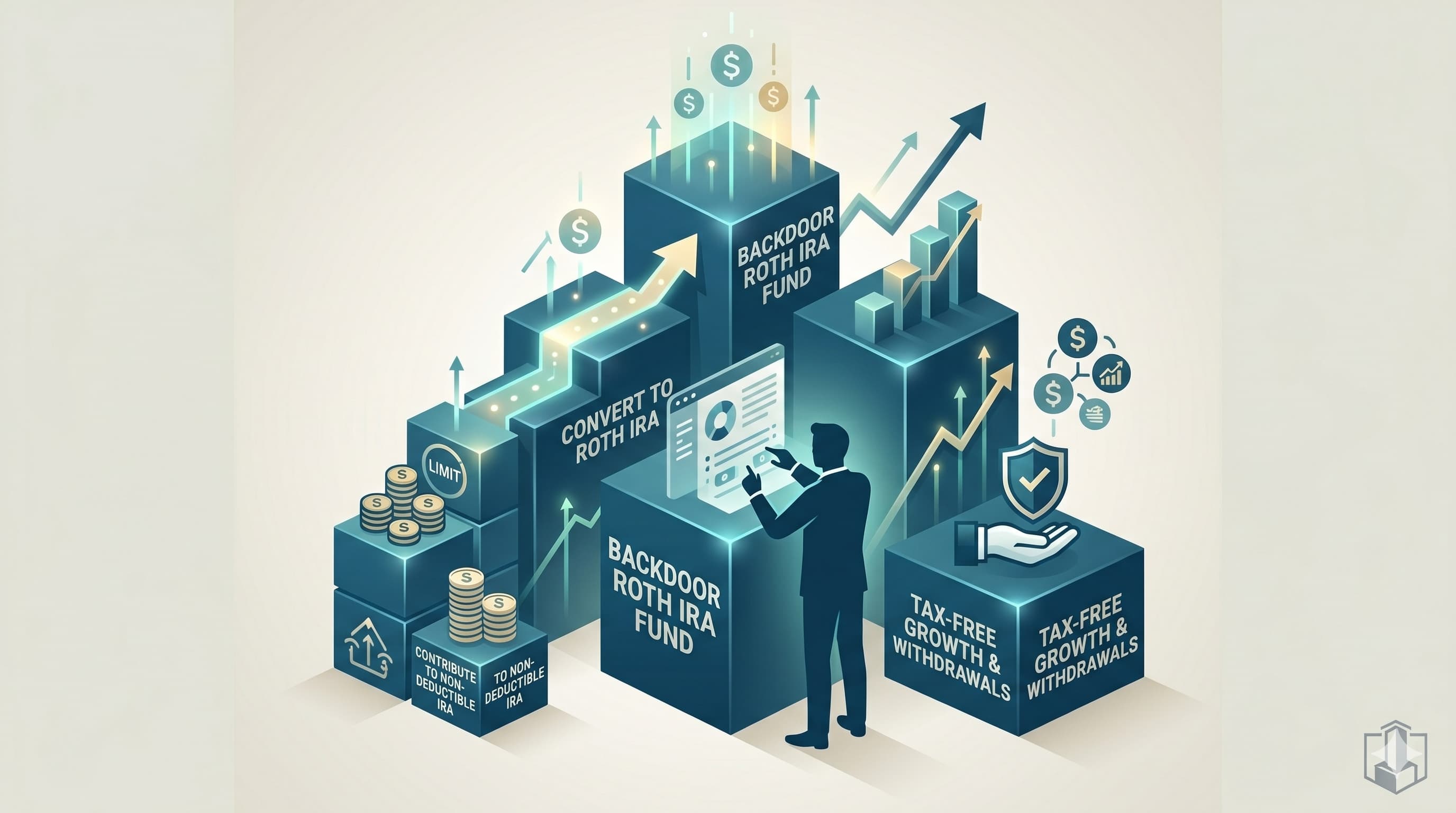
- Step 1: Non-Deductible Contribution to a Traditional IRA. You contribute after-tax money to a Traditional IRA. Since your income is too high to deduct Traditional IRA contributions, this contribution is considered "non-deductible."
- Step 2: Convert to a Roth IRA. Shortly after, you convert that non-deductible Traditional IRA contribution into a Roth IRA. Because the initial contribution was made with after-tax money, this conversion is typically a non-taxable event (or minimally taxable).
This strategy effectively allows you to get new money into a Roth IRA, providing access to its tax-free growth benefits, even if your income exceeds the direct contribution limits.
The Step-by-Step Process for a Backdoor Roth IRA
Executing a backdoor Roth IRA requires precision and careful documentation. Here’s a detailed breakdown:
- Open a Traditional IRA Account (if you don't have one). This account will be the initial holding place for your contribution. You can open one with most brokerage firms or financial institutions.
- Make a Non-Deductible Contribution. Contribute the maximum allowable amount to your Traditional IRA for the year (e.g., \$7,000 for 2024, or \$8,000 if age 50 or older). It's crucial that this contribution is designated as "non-deductible" on your tax forms. You fund this with after-tax money, meaning you won't claim a tax deduction for it.
- Convert the Funds to a Roth IRA. Soon after your Traditional IRA contribution clears (often within a few days or weeks), initiate a "Roth conversion" with your brokerage firm. You will instruct them to move the funds from your Traditional IRA to your Roth IRA.
- Report the Transaction to the IRS. This is a critical step for tax planning. You must file Form 8606, "Nondeductible IRAs," with your annual tax return. This form documents your non-deductible Traditional IRA contribution and the subsequent Roth conversion, proving to the IRS that the converted funds were already taxed and should not be taxed again.
- Real-world scenario: Sarah, a tech executive earning \$250,000 a year, wants to invest in a Roth IRA but exceeds the income limits. In January, she contributes \$7,000 (after-tax) to a Traditional IRA. A week later, she calls her brokerage to convert that \$7,000 into her Roth IRA. At tax time, her accountant helps her complete Form 8606 to report this transaction, ensuring the conversion isn't taxed.
Who Should Consider a Backdoor Roth IRA?
The backdoor Roth IRA is specifically designed for a particular demographic, making it a powerful high income roth strategy.
- High-Income Earners Exceeding Roth IRA Limits: This is the primary group. If your income prevents you from contributing directly to a Roth IRA, a backdoor Roth is your path to accessing its benefits.
- Individuals Expecting Higher Tax Brackets in Retirement: If you believe your income in retirement will be higher than your current income, or if tax rates are likely to increase in the future, the tax-free withdrawals of a Roth IRA become incredibly valuable.
- Those Seeking Tax Diversification: A well-rounded retirement portfolio often includes funds that are taxable (like a 401(k)), tax-deferred (like a Traditional IRA), and tax-free (like a Roth IRA). A backdoor Roth helps achieve this crucial diversification.
- Young Professionals with High Earning Potential: Even if your income isn't sky-high yet, if you anticipate reaching those income thresholds in the future, establishing a backdoor Roth early allows more time for tax-free compounding.
Here's a comparison of a Backdoor Roth IRA with other common retirement savings options for high earners:
| Feature | Backdoor Roth IRA | Traditional 401(k) / IRA (Deductible) | Taxable Brokerage Account |
|---|---|---|---|
| Contribution Limit | \$7,000 (2024) / \$8,000 (age 50+) | High (e.g., \$23,000 for 401(k) + catch-up) | Unlimited |
| Tax Treatment (Growth) | Tax-free | Tax-deferred | Taxable annually (dividends, capital gains) |
| Tax Treatment (Withdrawal) | Tax-free (qualified) | Taxable as ordinary income in retirement | Taxable (capital gains upon sale) |
| Income Limits | No direct limit for strategy, but requires non-deductible Traditional IRA | High income may limit deduction for Traditional IRA | None |
| Access to Funds | Penalty-free after 5 years / age 59.5 for contributions | Penalties for early withdrawal before 59.5 | Anytime, subject to capital gains tax |
| Estate Planning | Favorable for heirs (tax-free inheritance) | Taxable inheritance for heirs (pre-tax money) | Step-up in basis for heirs, reducing capital gains |
Common Pitfalls and the "Pro-Rata Rule"
While straightforward in concept, the backdoor Roth IRA has one significant trap for the unwary: the "Pro-Rata Rule." This rule applies if you have existing pre-tax money in any Traditional IRA, SEP IRA, or SIMPLE IRA.
The Pro-Rata Rule states that if you convert only a portion of your Traditional IRA funds to a Roth, the converted amount is considered to come proportionally from both your pre-tax and after-tax (non-deductible) contributions across all your Traditional IRA accounts. This means you can't simply convert only the non-deductible portion and avoid taxes.
Example of the Pro-Rata Rule:
Let's say you have \$93,000 in a pre-tax Traditional IRA from old 401(k) rollovers, and you just made a new \$7,000 non-deductible contribution. Your total Traditional IRA balance is now \$100,000. If you convert only the new \$7,000, the IRS views it as 93% pre-tax and 7% after-tax. So, \$6,510 of your \$7,000 conversion would be taxable!
To avoid the Pro-Rata Rule and ensure your backdoor Roth IRA conversion is tax-free, you generally have two main strategies:
- The "Clean Slate" Approach: If you don't have any existing pre-tax money in Traditional IRAs (or have already emptied them), you're in the clear.
- Reverse Rollover: If you do have pre-tax Traditional IRA money, you can often roll those funds into your current employer's 401(k) or similar retirement plan (if the plan allows). This effectively removes the pre-tax funds from your Traditional IRA universe, leaving only the non-deductible contribution to convert.
Here are some common mistakes to avoid:
- Ignoring the Pro-Rata Rule: The biggest mistake that can lead to unexpected tax bills. Always assess your total Traditional IRA balances before attempting a backdoor Roth.
- Not Filing Form 8606: Failing to properly report your non-deductible contributions and conversions can lead to the IRS believing you owe taxes on the entire converted amount.
- Waiting Too Long to Convert: While not a hard rule, converting immediately minimizes the chance of any investment gains accruing in the Traditional IRA, which would then be taxable upon conversion.
- Contributing More Than the Annual Limit: Adhere strictly to the annual IRA contribution limits.
Conclusion
The backdoor Roth IRA is an invaluable high income roth strategy for sophisticated investors and a critical component of smart tax planning. It allows individuals who are otherwise locked out of direct Roth IRA contributions to still harness the power of tax-free growth and withdrawals in retirement.
While the process involves a few more steps and requires careful attention to rules like the Pro-Rata Rule, the long-term benefits of tax-free wealth accumulation are significant. If your income exceeds the direct Roth IRA contribution limits, understanding and implementing this strategy can be a game-changer for your retirement savings. For personalized guidance, especially if you have existing Traditional IRA balances, consulting with a qualified financial advisor or tax professional is highly recommended to ensure you navigate the process flawlessly.
Frequently Asked Questions
Is the backdoor Roth IRA still legal in 2025?
As of the 2025 tax year, the backdoor Roth IRA strategy remains legal. The Build Back Better Act (2021) had proposed eliminating it, but the provision was not enacted. The strategy has been in use since 2010 when Roth conversion income limits were removed. That said, Congress could revisit the issue — it has appeared in multiple legislative proposals. The strategy's legality relies on IRS Notice 2014-54, which confirmed that after-tax contributions can be converted to Roth. Work with a tax professional annually to confirm current rules apply to your situation.
What is the pro-rata rule and why does it matter for backdoor Roth?
The pro-rata rule requires you to treat all your IRA balances as a single pool when calculating the tax on a Roth conversion. If you have $90,000 in a pre-tax Traditional IRA and contribute $7,000 in after-tax funds, your IRA pool is $97,000. Converting $7,000 means only 7.2% ($7,000 / $97,000) is treated as after-tax and tax-free; the remaining 92.8% is taxable. This effectively eliminates the tax-free benefit of the backdoor strategy for anyone with significant pre-tax IRA balances. The solution is to roll pre-tax IRA funds into an employer 401(k) before executing the backdoor Roth.
How do I report a backdoor Roth IRA on my tax return?
You will need to file Form 8606 (Nondeductible IRAs) with your federal return. Part I reports the nondeductible contribution to the Traditional IRA. Part II reports the conversion to Roth. The IRS uses Form 8606 to track your basis (after-tax contributions) and ensure you are not taxed twice on the same dollars. Failing to file Form 8606 when you make nondeductible contributions is a $50 penalty and can create tax complications when you withdraw in retirement. Keep copies of all Form 8606 filings permanently — you may need them decades later.